Federal Public Comment Period: A Summary

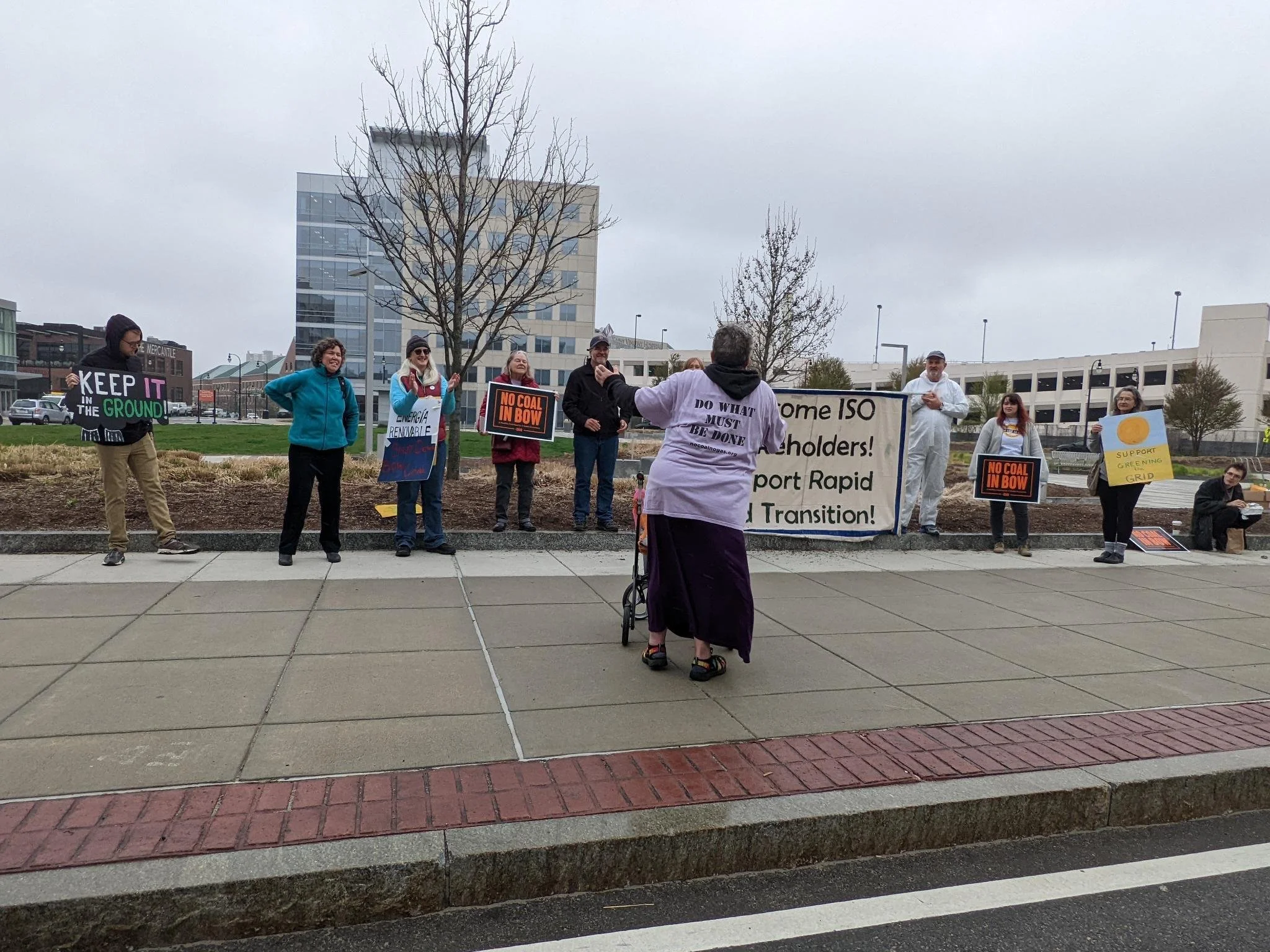
No Coal No Gas submitted over 150 comments to the Federal Energy Regulatory Commission (FERC), opposing ISO New England’s latest forward capacity auction results, which continued funding the coal-fired Merrimack Station. 

Then, ISO New England filed a response to our comments, arguing that they were “outside the scope” of the proceeding. 

In response, No Coal No Gas filed more motions with FERC to reiterate that considering the scope of the climate crisis is necessary in energy policy. We filed an official motion to intervene in the docket, followed by an official response (called “Motion for Leave to File Answer and Answer”) to ISO New England’s response to our comments. We also filed a comment with FERC’s Office of Public Participation, inquiring just when the climate crisis will be officially considered “inside the scope” of energy policy. 

We know that many decision makers in the system have read our latest filings, AND we received a direct email from the Office of Public Participation’s senior policy advisor. We are looking forward to meeting with OPP’s senior policy advisor and will post an update later this month!

Some quotes from our filings: 

“Subsidizing a coal plant is a lose-lose situation. If the Merrimack station runs, it produces toxic air and water pollution with long-proven harmful effects on the health of nearby communities and ecosystems. In addition, carbon emissions from coal are among the highest contributors to the worsening climate crisis….Given all that, you might be tempted to argue that the status quo is fine because the plant is only there for backup, and doesn’t run often. It is not fine. It means we’re spending millions of dollars every year to prop up a generating station that hardly even gives us any electricity. Say what? That money could be invested in solar and wind projects, in grid modernization to support more local generation, or in energy-efficiency incentives that reduce our region’s overall consumption. All of those options would put New England in a stronger position going forward.” —Comment by Marisa Keller

“If these proceedings are to be defined in a manner sufficiently narrow that they should fail to account for the fundamental facts upon which they are based, it rapidly becomes impossible to ensure the “reliable, safe, secure, and economically efficient energy services” described in FERC’s mission. For example, if the ISO’s FCA results were determined by valuing the United States dollar at half its current worth, they would be dramatically—perhaps catastrophically— different from results based on reality. Or, for example, if the FCA results were determined based on regional energy demand figures from twenty years ago, they would be dramatically—perhaps catastrophically—different from results based on reality. Both of these would clearly be relevant to whether the ISO had followed its Tariff and conducted a legitimate FCA. That is, in order to follow that Tariff, the factual world must be accounted for. The climate crisis is just as factual and just as connected to grid management as the value of the United States dollar and the current regional energy demand.” —Isaac Petersen, in the NCNG Motion to Answer 

“The purpose of subsidies is to contribute to the common good. It is clear we need to shift away from dirty legacy generators toward subsidizing and promoting increased energy reliability, job creation, pollution reduction, the promotion of equity, and a more sustainable climate.” —Comment by Becky Jones

“When will the 3 deaths a year caused by the Merrimack Station be “inside the scope?”...When will the threat of climate change to New England residents, to our regional grid reliability, and to people around the world be relevant to decision making around grid policy? When will the scientific requirements for the existence of life on Earth be related to whether or not we fund coal and other fossil fuels years into the future? We have tried all the proper channels, from stakeholders meetings to lawsuits to meetings with our representatives, and nothing has worked. Yet when the dysfunction and danger of this situation leads us to civil disobedience, we are told that ‘this democracy works.’ Well, if this democracy works, where is your power? Where is the ability of the Federal Energy Regulatory Commission to say that justice and collective survival are within the scope of concern?....When will you realize that the crisis we are facing will not wait to be “ripe for comment,” that….there will be no electric grid or “proper procedural process” if the fossil fuel industry, given free rein by your commitment to bureaucracy, destabilizes and destroys our communities, society, and species?” —Leif Taranta, in NCNG’s Comment to the FERC Office of Public Participation

“It is a moral outrage for us as consumers to be forced to continue to subsidize the pollution of our planet and destruction of our climate. This benefits nobody except the owner of the Station. We should be investing in cheaper renewable energy and in energy efficiency instead. Do not put off this decision. Have courage.” —Comment by Sarah Thorne

“Merrimack Generating Station…would appear to benefit no one economically, except its private investors; it pollutes the beautiful Merrimack River and kills fish. Basically, it’s a disaster for public health and environmental justice.” —Comment by Siobhan Senier

“It's irresponsible and short-sighted to spend hundreds of millions of dollars of ratepayer money to keep a dirty and climate-damaging technology alive.” —Comment by Wharton Sinkler

“As a parent of two young children, ages ten and six, I have tremendous concern over the health and safety of our collective future. What will their futures look like? Will they have access to clean water, breathable air, and healthy soil?” —Comment by Abby Mnookin

“As a small farmer, the impacts of climate change have already reached me and other growers.  The state of NH's unwillingness to move to renewable energy and take climate disruption seriously is distressing for all of us who want to contribute to a resilient community and NH's ability to feed itself locally.” —Comment by Amy Antonucci

“We need to immediately cease subsidizing fossil fuels and route those subsidies into renewable energy. If we had begun this process a decade ago, the transition would likely be almost complete. Why do we continue to bolster a dying and destructive industry?” —Comment by Amanda Nash

JUDGE SENTENCES CLIMATE ACTIVISTS WITH INTENT TO DETER EFFECTIVE ACTION, ENCOURAGES SYMBOLIC ACTION

JUDGE SENTENCES CLIMATE ACTIVISTS WITH INTENT TO DETER EFFECTIVE ACTION, ENCOURAGES SYMBOLIC ACTION

Four climate activists from No Coal No Gas were sentenced by Judge Andrew Schulman in Merrimack County Superior Court on Friday, May 13th, following their three-day jury trial in March of 2022. This decision comes after the jury found the four guilty of criminal trespass and railroad trespass during a Hooksett coal train blockade in 2019. Over 65 fellow activists supported the defendants in-person and online during the hearing. The 2019 train blockade was a response to the continued use of coal at Merrimack Station in Bow, New Hampshire - the last coal-fired power plant in New England.

CASTLETON DIVESTS FROM MERRIMACK STATION

CASTLETON DIVESTS FROM MERRIMACK STATION

Who just divested from coal? CASTLETON COMMODITIES, which owned 50% of the Merrimack Generating Station. For years, the commodities trading firm Castleton Commodities and private equity firm Atlas Holdings propped up the extraction, transit, processing, combustion, and waste generation of coal in New England as the co-owners of Granite Shore Power, which in turn owns Merrimack Station.

Verdict Reached in the Jury Trial Case Against Coal

Verdict Reached in the Jury Trial Case Against Coal

CONCORD, NH -- After a three day trial in Merrimack County Superior Court and four hours of deliberation, the jury reached a decision regarding the 2019 Hooksett coal train blockade.

The jury found Johnny Sanchez not guilty of resisting arrest, found Emma Schoenberg not guilty of criminal trespass or railroad trespass, and found Dana Dwinell-Yardley, Daniel Flynn, Jay O’Hara, and Johnny Sanchez guilty of criminal trespass and railroad trespass.

ISO Study Assumes Merrimack Station Retirement

The core tenets of our campaign are that we are here to build community and expand what type of resistance and change is possible, without relying on those in power to do what must be done. At times, that boldness has been met with silence by those who could decide to close this coal-fired power plant for good. Meanwhile, as a campaign we have built and sustained collective power. Now, decision makers are taking us seriously and are engaging us in discussions about the coal plant. We are in conversation with multiple stakeholder groups, and Gordon Van Welie, CEO of regional grid operator ISO New England personally reached out to us a month ago. 

This week, ISO New England released a draft of a study titled, “Pathways Study: Evaluation of Pathways to a Future Grid.” In the report, the Analysis Group delivered an evaluation of policy options that will result in an electricity grid that can support the delivery of energy in ways that are aligned with existing state energy policies. The study looks at potential economic and regulatory practices for moving New England's electricity grid away from fossil fuels, while accounting for our current energy resource mix and potential to expand renewable sources. 

Reading through this study, we were frustrated by its focus on conservative market-based solutions to the violence of climate change. Yet deep within the 159 pages, we found something fascinating: this study assumes that all the region’s coal resources will retire by June 1, 2025. The section of the study that outlines the researchers’ assumptions states: 

“We assume the following changes to the resource fleet:

  • entry by resources that cleared capacity in the 2024-2025 Forward Capacity Auction (“FCA 15”),

  • scheduled retirements, reflecting the ISO-NE list of retirements as well as other publicly announced retirements,

  • retirement of all coal resources in the region by June 1, 2025, and

  • renewable entry from “baseline state policies,” reflecting announced contracts, state legislated procurements, and state legislated goals, which we discuss in more detail in Section II.D.” (Schatzki et al. 25)

The study addresses what the energy resources on our electric grid will look like, and the authors note, “These data are then adjusted for other expected generation resource additions and known retirements. Additionally, we assume the Merrimack 1 and Merrimack 2 coal plants will retire on June 1, 2025” (Schatzki et al. 122). Assuming that coal will be off grid by June  2025 allows ISO New England to fulfill the existing forward capacity contract, since the Merrimack Generating Station is already funded through June 2025. However, for this study’s core assumptions to be accurate, Merrimack Station in Bow, NH must not qualify for forward capacity payments in the 2022 auction.

While this is not an official retirement announcement, the authors of this study clearly expect that the Merrimack Station will retire by June 1, 2025. In other words, the ISO’s own commissioned study clearly considers future forward capacity payments to the Merrimack Station to be out of line with status quo policies, let alone with necessary future solutions and recommended changes.

Despite generally proposing slow, unimaginative, and otherwise moderate grid transition measures, this study considers it a no-brainer that ISO New England will take coal off the grid as soon as possible. If ISO New England grants the Merrimack Station forward capacity payments in the 2022 auction, that would undermine the conclusions of their study and call into question their commitment to comply with existing state energy policies.

(Figure: Schatzki et al. 45. This stacked bar chart depicts the generation capacity of various energy sources over the course of a number of years (‘21 -’39). Coal, represented by the color black, appears as a small wedge that tapers out of generation capacity by mid-2024. You can spot it just below the orange nuclear section.) 

A key demand for our campaign is the total shutdown of the Merrimack Station, and this study assumes that result. While we certainly have bigger dreams than this study does, we are actively changing the equation for coal in the region. 

We’ve long known that coal is a dead industry. This study suggests that decision makers in New England are realizing this, too. We dream of a day when all of our campaign demands are assumptions in official studies, when community building and justice are the constant variables we use to shape our world. As part of that dream, we will keep pushing this issue beyond capitalist, market-based policy recommendations and uninspired solutions. In the meantime, we will keep a vigilant eye on ISO New England as we continue to participate in ongoing direct resistance to Merrimack Station and other fossil fuels.

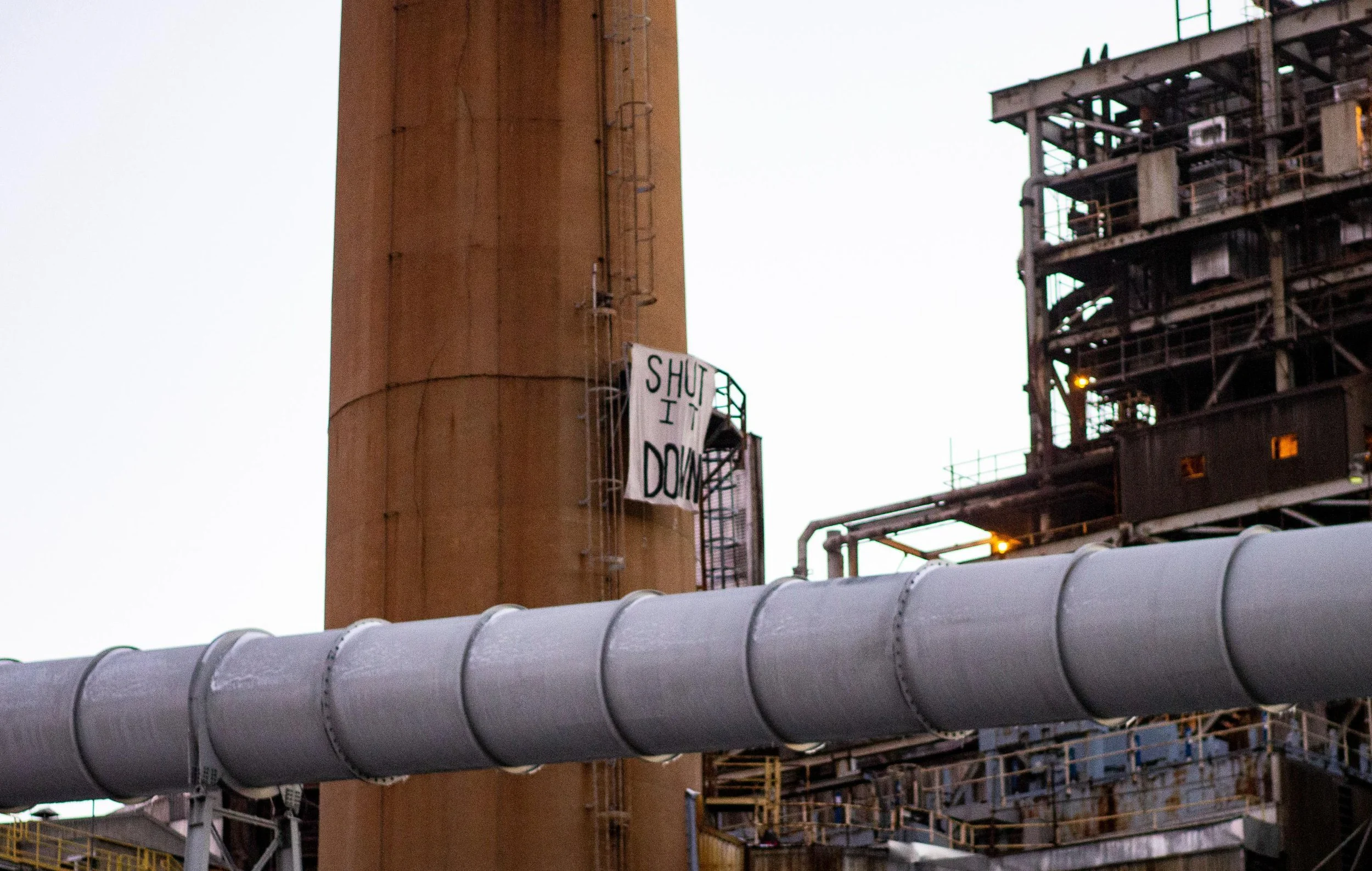
Activists scale smokestack at NH coal plant and Release "Shut It Down" Banner

Activists scale smokestack at NH coal plant and Release "Shut It Down" Banner

Around 4:00pm on January 8th, 4 activists entered the property of the coal-fired Merrimack Generating Station, which was running at the time. Two scaled the inactive smokestack and dropped a banner reading "Shut It Down," while two locked themselves to the base of the stack. They remained there for over six hours, demanding that the plant's owners publicly commit to filing a delist bid when they participate in the upcoming auction determining which power plants will receive ratepayer funding to be on stand-by for the New England electric grid.

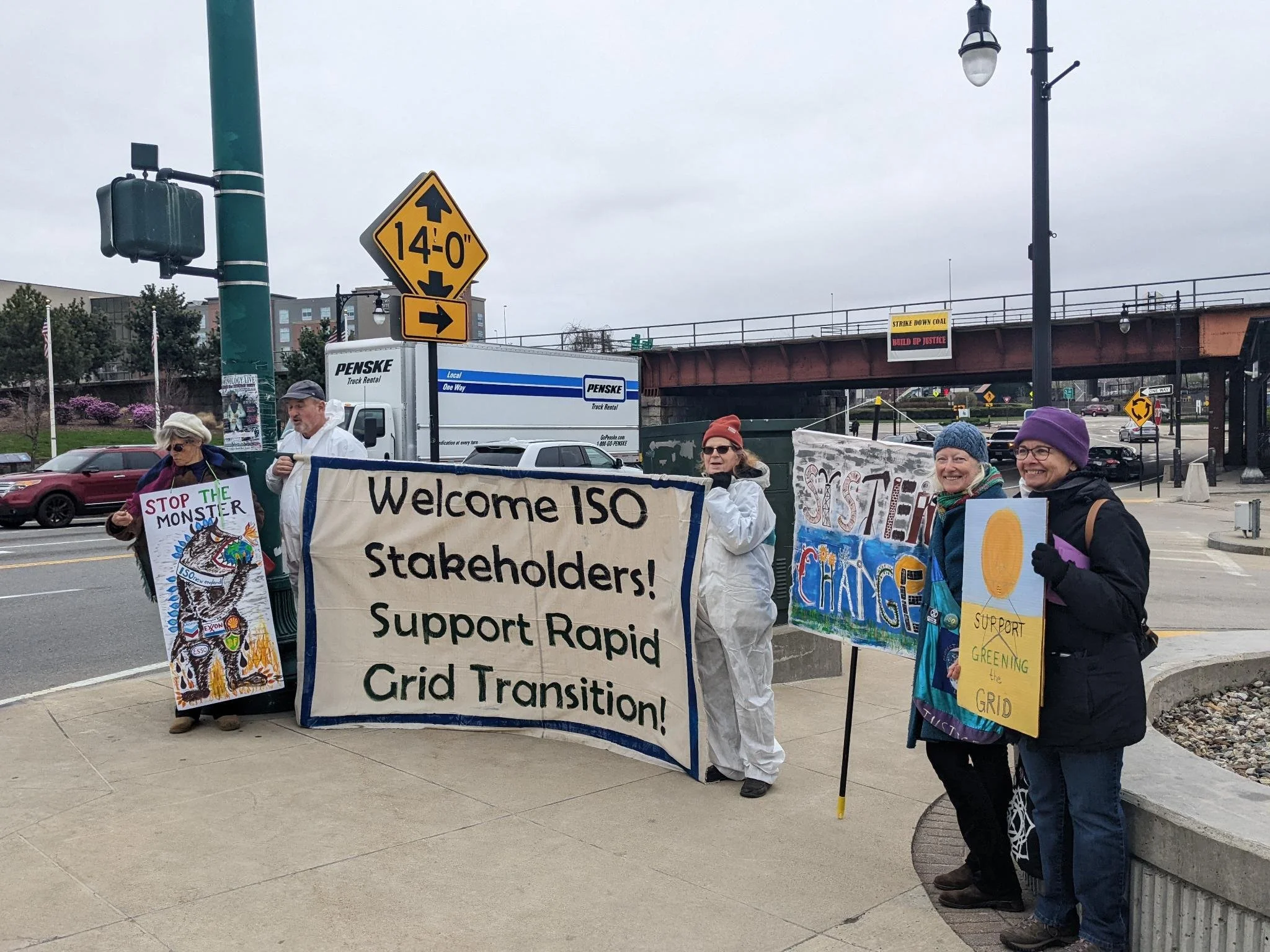
All Eyes on ISO New England

By Steven Botkin

Most people have never heard of ISO New England. And yet, this organization is responsible for managing the electric power grid for all of New England. That means making sure that every residence and business throughout the six states has a reliably continuous flow of electricity. That means contracting with many different power producing companies to buy enough energy to meet all of the demands for electricity, and then some. And that means providing funding to maintain existing power plants and to build new power producing and transmission infrastructure. 

The problem is that ISO New England has not recognized environmental, public health and social costs in their calculations about where to buy their energy. They say “all electrons are neutral,” as if it doesn’t make a difference whether it’s produced by burning coal or by collecting solar energy. So, ISO New England funnels millions of dollars to keep fossil fuel burning power plants operational. And ISO’s invisibility has allowed them to continue to prop up the fossil fuel industry, even in the face of undeniable evidence of its complicity in the climate crisis.

Until now.

In November 2019, seven United States Senators from New England sent a letter to ISO New England President and CEO Gordan van Welie stating “ISO-NE is not considering the region's environmental and climate goals…[and] appears to be pursuing a patchwork of market reforms aimed at preserving the status quo of a fossil fuel-centered resource mix ...which will force consumers to pay millions of dollars to existing, polluting power plants with on-site fuel supplies, such as oil, coal, or liquefied natural gas.”

In December 2019, Massachusetts Attorney General Maura Healey launched an effort to educate Massachusetts families and businesses about the substantial public health and economic costs of fossil fuel usage and encourage them to call on ISO-New England to set market rules that support cleaner energy resources and protect the climate (see the video and the petition to ISO).

And the month after that, January 2020, Connecticut Governor Ned Lamont’s Commissioner of Energy and Environmental Protection said a “lack of leadership” at ISO-New England on the issue of cutting the use of fossil fuels has Connecticut evaluating whether the state should leave the regional power grid. He said ISO-New England’s policies are driving larger investments in natural gas pipelines and power plants that this state “doesn’t want and doesn’t need.”

Sensing new opportunities for leveraging change, climate activists began showing up at the gates of the ISO headquarters in Holyoke, Massachusetts, and sending letters to Gordon van Welie, ISO’s President and CEO, amplifying the messages from the New England states and demanding that ISO stop subsidizing fossil fuels. 

Feeling pressure from all these sources , Gordon van Welie gave a presentation on March 10, 2020 titled New England’s Wholesale Electricity Markets: The Clean Energy Transition and Future Pathways. In it, he claims “ISO New England is currently enabling the Clean Energy Transition through a competitive market for power system reliability services.” He emphasizes the reliability challenges of renewable energy, and the need for “balancing resources” (e.g. fossil fuels) to fill in the gaps. He highlights the tension on ISO between FERC regulations that require “resource neutrality” in the market design (i.e. not taking into account the environmental costs), and the new clean energy standards established by New England states. And he concludes by saying, “If a transition to a new pathway is required, the timeframe would be towards the latter part of this decade….We are not currently planning further major market structure changes.”

Understanding the inadequacy of van Welie’s response, in October 2020 governors of Maine, Vermont, Massachusetts, Rhode Island and Connecticut signed a New England States Vision Statement calling for critical changes to ISO New England’s regional energy system. They state, “New England’s wholesale markets fail to sufficiently value the legally-required clean energy investments made by the ratepayers they serve.  Absent fundamental changes, the result of the existing market structure will be that some states’ ratepayers will continue to overpay for electricity, constrained by a wholesale market not aligned with a rapidly transitioning resource mix and consumer investments in clean energy and decarbonization.  That is not a sustainable outcome.”

They directly accuse ISO New England’s governance for not giving “a sufficiently meaningful voice to State and consumer interests and its mission does not reflect the relationship between ISO-NE’s functions and the New England States’ legal requirements, policy imperatives, and associated consumer interests. Transparency in the stakeholder process and with ISO-NE Board decisions is also a key concern for the New England States.  Public access to these processes is inadequate, especially when compared to some other ISOs and grid operators across the country.  This lack of transparency and accountability in ISO-NE’s governance structure undermines public confidence in ISO-NE as the entity ultimately responsible, subject to stakeholder feedback and federal approval, for determining resource adequacy and system planning and operation requirements for the region.” 

Inspired by these explicit public challenges for accountability, almost 100 comments were submitted in March and April 2021 to the ISO’s regulatory body, the Federal Energy Regulatory Commission (FERC), challenging ISO’s use of its “forward capacity auction” for subsidizing fossil fuel burning power plants. 

And still, Gordon van Welie dragged his feet

In June 2021, the New England States Committee on Electricity (“NESCOE”) issued a Report to the Governors. In it they summarized the recommendations from a series of forums held following the release of the New England States’ Vision Statement the previous year. These recommendations, once again, directly challenge ISO New England to make critical changes to ISO New England’s regional energy system by pursuing “a new, regionally-based market framework that delivers reliable electricity service …[and] accounts for and supports States’ clean energy laws in an efficient and affordable manner.”

They note that ISO-NE currently does not conduct a routine transmission planning process that helps “to inform all stakeholders of the amount and type of transmission infrastructure needed to cost-effectively integrate clean energy resources and DERs across the region.  The need for such planning has become paramount.”  

And, as far as governance, they declare “ISO-NE’s governance does not give a sufficiently meaningful voice to State and consumer interests and its mission statement does not reflect the relationship between ISO-NE’s functions and the New England States’ legal requirements, policy imperatives, and associated consumer interests…. To date, agendas of an ISO-NE Board Committee indicate governance and transparency discussion; however, no process has been convened or proposal advanced.”

Seeing the writing on the wall, on September 23rd the ISO Board of Directors released a “Response to the New England States’ Vision Statement and Advancing the Vision Report.” They begin the report stating “The ISO Board of Directors has directed management to prioritize transmission planning studies and market pathways analysis in support of the states’ clean energy vision.”  Emphasizing that “ISO New England Is aligned with the States on the clean energy transition,” they lay out their position in three bullet points.

  • The states have clean-energy mandates – and we are supportive of the states in those efforts

  • The ISO has a reliability mandate and a mandate to administer competitive wholesale markets for the resources needed for a reliable system – and we know that the states recognize the importance of reliability and have continued to express support for competitive markets

  • There is an overarching need to ensure a reliable power system throughout the clean energy transition

They describe studies currently underway on how to transition the New England power grid in response to States’ environmental policies. The Future Grid Reliability Study is examining the implications of a substantially-changed grid (study year 2040), where the majority of the resource mix is clean intermittent and battery storage resources. (“Phase 1” report is due in the first quarter of 2022). The Pathways to the Future Grid study is comparing the effectiveness and efficiency of two potential market frameworks - a new Forward Clean Energy Market and a net carbon pricing framework (a report is scheduled for April 2022). Transmission Planning for the Clean Energy Transition is a pilot study to plan for growing levels of Distributed Energy Resources (DERs), renewable resources, and energy storage into the grid (results to be released in fall 2021).

As far as governance, the ISO Board says they “have reviewed their current practices in light of the states’ recommendations...and are making changes” in terms of board meetings, charter revisions and enhanced communications, and call for increased levels of input and decision-making from state regulators and policymakers. 

NESCOE was not satisfied. In a meeting with the ISO Board on November 1, they state ISO “largely maintains the status quo” governance structure, and “fell short in addressing the need for structural changes that we identified. The days are past when what we primarily asked of ISO-NE was to run fuel neutral markets and plan for and operate reliability-based transmission.”

While there is evidence in recent communications from Gordon van Welie and the ISO Board of Directors that decarbonization is now being taken seriously, they continue to justify the system of competitive wholesale electricity markets that perpetuate the ongoing use of fossil fuels. 

So, in the New England state houses, governors offices and attorneys general offices, in the advocacy and grass-roots activist groups, and in the homes and communities of residents throughout the region, we are all waiting and watching for the results of the ISO studies, and the recommendations that follow. We are watching to see if ISO takes seriously the decarbonization mandate and sets that stage for rapid retirement of fossil fuel burning power plants, beginning with the Merrimack Station coal plant. And we are watching to see if ISO is bold enough to set up a new forward clean energy market to drive this transition, and willing to stop using fears about reliability as their excuse for continuing to unnecessarily prop up the fossil fuel industry.

ISO recently took an important step in terminating a contract with the natural gas power plant in Killingly Connecticut. However, all eyes are on the ISO to see if they can rise to the occasion and provide leadership in the great challenge that is before us.

​​​​​​​Fireworks and Climate Carolers Call for End of Coal

Bow and Concord, NH - Environmental activists representing Extinction Rebellion, No Coal No Gas, and 350NH launched cascades of fireworks near Merrimack Generating Station this evening to draw attention to the immorality of burning coal in the escalating climate crisis. In a coordinated action, images of fireworks and flares coupled with messages about the role of coal in climate change were projected onto buildings in downtown Concord to highlight the issue to residents of New Hampshire's capital.

"I am desperate," said participant Sue Durling, a grandmother from Hillsborough. "We are experiencing a climate crisis. No one seems to be listening, and our government and media are not acting like the science is real. We are sending up flares because that's what people do to attract attention in an emergency." By participating in the action, Durling was violating her bail conditions following an October 3 arrest during a protest at the property of Granite Shore Power, operators of the Merrimack station.

Activists directed chants in the direction of the power plant and expressed their willingness to risk jail time during the holiday season. "I believe the best gift I could give to my family and the planet would be to wake up the public to the catastrophe that is already beginning to change our world," said Karen Bixler of Bethel, Vermont. Lumps of coal were left as a gift to the power plant, addressed to “our naughty neighbors at Merrimack Generating Station”.

Meanwhile, carolers serenaded shoppers on Main Street in Concord on one of the busiest shopping days of the year. Traditional holiday tunes were updated with climate conscious lyrics, transforming them to call attention to the urgency. The public were encouraged to sing along with projected karaoke videos that were interspersed with environmental messages.

The Merrimack Generating Station in Bow, NH, is the last coal-fired power plant in New England that isn't yet scheduled to be shut down.[1] The station is considered a "peaker plant" because it currently operates only during peak electrical demand, but coal is the least efficient and most harmful method for this purpose.[2] [3]​​​​ [4] When operating at full capacity, the plant emits as much carbon dioxide in one hour as it takes the average American to expend in 26 years.[5] The recent addition of expensive "scrubbing" technology, aimed at reducing carbon emissions from the plant, resulted in a barely noticeable decrease.

The Merrimack plant has exacted a heavy financial toll on the local, state, and regional population. Over $188 million was earmarked for subsidies to Granite Shore Power to keep the Merrimack station open between 2018 and 2023. The recent addition of the failed carbon scrubbers cost $500 million; a cost passed on to ratepayers across New England. Additionally, the Supreme Court of New Hampshire recently ordered the taxpayers of Bow to reimburse the plant owners $10 million due to property tax evaluation errors. These financial burdens contribute to the average New Hampshire utility bill being one of the highest in the nation.[6] Without these subsidies our bills would be 10-20% lower.[7]  

Meanwhile, the health risks of breathing polluted air and environmental harms to the Merrimack River remain in Bow residents’ backyards. Emissions from coal power plants contribute to diseases including asthma, bronchitis, lung cancer, heart disease, and stroke. These pollutants interfere with lung development, increase the risk of heart attacks, and compromise intellectual capacity.  Sulfur Dioxide (SO2) from burning coal affects the respiratory system, causes irritation of the eyes and makes people more prone to respiratory tract infections.[8] [9] Even unburned coal piles have been shown to negatively affect health of people living within a 25 mile radius.[10]

In New England, coal makes up just 1% of generated electrical power, but it's a disproportionately dirty and greenhouse-gas-emitting slice.[11]  Coal is the most polluting fuel in use, and is particularly harmful to Earth's fragile climate and ecological diversity.

As the largest historical emitter, the United States has a moral and legal responsibility to cut emissions sooner than the rest of the world.[12]  Delayed action will increase the economic and societal challenges brought on by climate change and ecological destruction.[13]  Despite public acknowledgement of the crisis, state and national political leaders continue to support subsidies - using the taxes of working people to fund dirty and obsolete fuel sources like coal and systems like Merrimack Generating Station.[14] [15] [16] We must stop releasing fossil fuel emissions into the atmosphere immediately.[17] 

When Merrimack station is shuttered for good, there needs to be a future both for the workers and the site on the banks of the Merrimack River. A transition must:

  • Re-utilize the plant facilities to replace losses in the tax base.

  • Create jobs restoring the site and fund job-creating community economic development.

  • Ensure a just transition for workers.

A just transition could begin by repurposing the millions of dollars in subsidies already earmarked for the plant. For example, the $188 million recently allocated to Merrimack could buy over 397 megawatt hours of renewable energy battery storage to respond to peak demand.  Combined with cleaning up the site and housing solar panels rather than coal piles, the plant in Bow could swiftly become a clean energy hub. [18]

ABOUT NO COAL NO GAS

No coal no gas is a regional nonviolent direct action campaign aiming to build a resilient community and shut down the last coal plant in New England, in Bow, NH. For more information about the campaign, visit nocoalnogas.org

ABOUT EXTINCTION REBELLION

Extinction Rebellion South Central New Hampshire is an autonomous chapter of the international grassroots movement, Extinction Rebellion (XR), which started in London in 2018. The purpose of XR is to tell the truth about how dire the ecological and climate crisis is and spark immediate action in order to prevent complete climate and ecological collapse. We aim to mobilize people around the world to utilize nonviolent direct action to demand that governments take radical action to avert societal collapse caused by widespread climate and ecological disaster, and to protect front-line communities, biodiversity, and the natural world. This movement is non-political, and unites all of humanity behind a singular goal of a just and livable future.

Photos and videos from this action can be accessed at https://bit.ly/3ldo6b2.

Two Years Ago

Hello friends,

I hope you are doing very well! I am so grateful to be a part of this organizing community, and I can’t believe how far we’ve come. I love this work and each and every one of you for being a part of it. I hope you’ll consider helping us sustain this campaign for the next year by donating to No Coal No Gas !

I’ve been reflecting on the anniversary of our train blockade in Hooksett, NH and the past two years I’ve spent in this campaign, and I wanted to share my reflection here with you!

Photo credit: Ceilidh Peden-Spear

Two years ago I leaned against the frigid, rusty steel of a train bridge and looked at the icy Merrimack river swirling below. A bright red Emergency Services raft flailed in the eddies, desperately trying - and failing - to chip through the ice. Above us, helicopter blades fractured the sky.

We’d been blockading the train for five straight hours at that point. This final action was the third blockade of the same coal train in 24 hours as it progressed north through New England communities. The train was filled with 10,000 tons of coal en route to the Merrimack Generating Station. This rusted train bridge was our last stand.The previous evening we’d sat around our glowing, buzzing phones until late, late at night as our friends in Worcester successfully stopped the train after waiting hours in the cold, dark woods for the train. Later on, we listened, sleepless, as the blockade in Ayer, MA held out through the wee hours of the morning. Finally, the sun rose and the train was drawing nearer to the coal plant. We held hands in a circle - anxious and determined as the train approached.

Just two days before I had said goodbye to my friends outside a Zapatista-run community center. I had spent three months in Mexico learning about the incredible organizing of Indigenous Mayan communities, campesinos, workers, and students, and about autonomy and resistance from “below and to the left.” And the entire time I've been thinking about what we could do in New England to be part of this struggle—how we could take matters into our own hands and stop the harm that’s happening, how we could build a better world without waiting for anyone’s permission. And I wasn’t sure exactly how to do that, or where I would go.

The sun started to dip as pigeons swarmed in a flock around the train bridge, lighting up their feathers in red iron and gold. Beneath us, cops and firefighters screamed about legality. I glanced over at my buddy Johnny’s frozen grimace as the sun slipped away, leaving us cramped and aching. Then, I heard our comrades across the water start to sing. From way over on the pedestrian bridge came the same song I had sung in the Zapatista safehouses, in housing co-ops and in union halls. As the hypothermia set in and the officers climbed up to arrest us - I knew then that I was home.

Photo Credit: Johnny Sanchez

Two years later, that action is still not over. Johnny and four others arrested on the bridge that day are headed to trial in the spring- still standing strong in the knowledge that what we did that day was just and necessary. I’m so proud of them, and excited for them to get their day in court.

This campaign is still going strong. There’s a lot that’s happened between then and now - from the ongoing pandemic and housing crisis, to the struggle to stop Line 3, the George Floyd uprisings, and so much more. One thing that hasn’t changed, for me at least, is No Coal No Gas’s commitment and tenacity. In the past years, No Coal No Gas folks have organized local mutual aid networks, defended our communities from violence and evictions, and trained dozens of new activists in de-escalation, organizing skills, and direct action. We’ve traveled across the country to throw down for Indigenous-led resistance struggles, and faced down both riot cops and white supremacists in our own backyards. Regionally, we’ve worked as a campaign to keep constant pressure on our regional grid operator, ISO New England- with our utility strike, coal deliveries, comment periods, and public protests. We’ve shown up powerfully together at the Merrimack Generating Station itself, as well as it’s corporate owners’ offices- taking direct action to prevent the plant from running and begin remediating the land around it. And through all of this, we’ve remained solid in our commitment to community building and to each other.

Photo credit: Rebecca Bealieu

Two years later, No Coal No Gas is my home. I’m constantly awed by the creativity and love that saturates everything we do, whether it’s a late night scheme session, a spontaneous art installation, or a long tender discussion on the way home from court. It’s been an honor to work with such an extraordinary set of people - pranksters and preachers, theater nerds and flame throwers and strategic researchers - people who are guided by ceremony, by deep care, by a willingness to put themselves against the wheels of destruction and the determination to build something better in their place. This is the same community that, very nearly literally, saved my life when I learned I had contracted COVID-19 while in a northern Minnesota jail, that taught me to drive while supporting a 24-hr sit in to Stop Line 3, this is the community that has become my family and some of my best friends. I know that No Coal No Gas has done the same for countless others and that the future is terrifying but our best chance of survival is each other.

Sometimes I feel scared when I think two years into the future. There is a lot of society left to unravel and a lot to be afraid of. However, I can still smile right in the face of an uncertain future. I know that there will be more handcuffs, coal smoke and police in the years ahead. I also know in my heart that there will be more music, more laughter, more of us balanced on those thin steel rails over the water - breathless and hanging on. I cannot wait to look back two years from now and think about all that we still have to fight for, and see how much more we’ll have to love.

Thank you so much and thank you, from the bottom of my heart, for being a part of this resistance network! If you can help us sustain this work, please consider donating to No Coal No Gas this year!

Lots of love,

Leif :)

Campaign Coordinator, No Coal No Gas

PS: Donating to No Coal No Gas goes directly back into the work we do. We appreciate each and every gift that allows us to come together, so keep an eye out for more fundraising emails from us as we wrap up the year and let your networks know. Thank you!