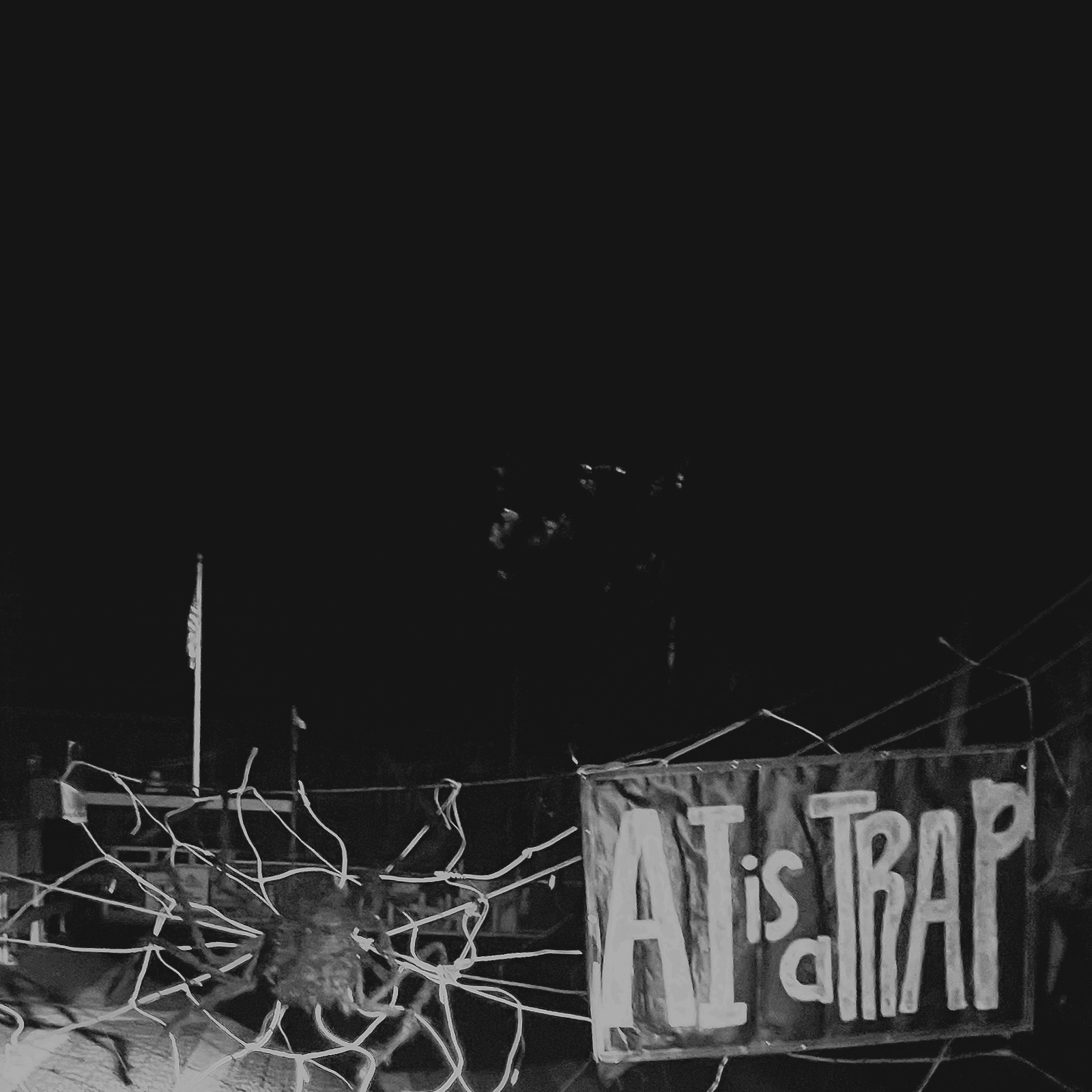
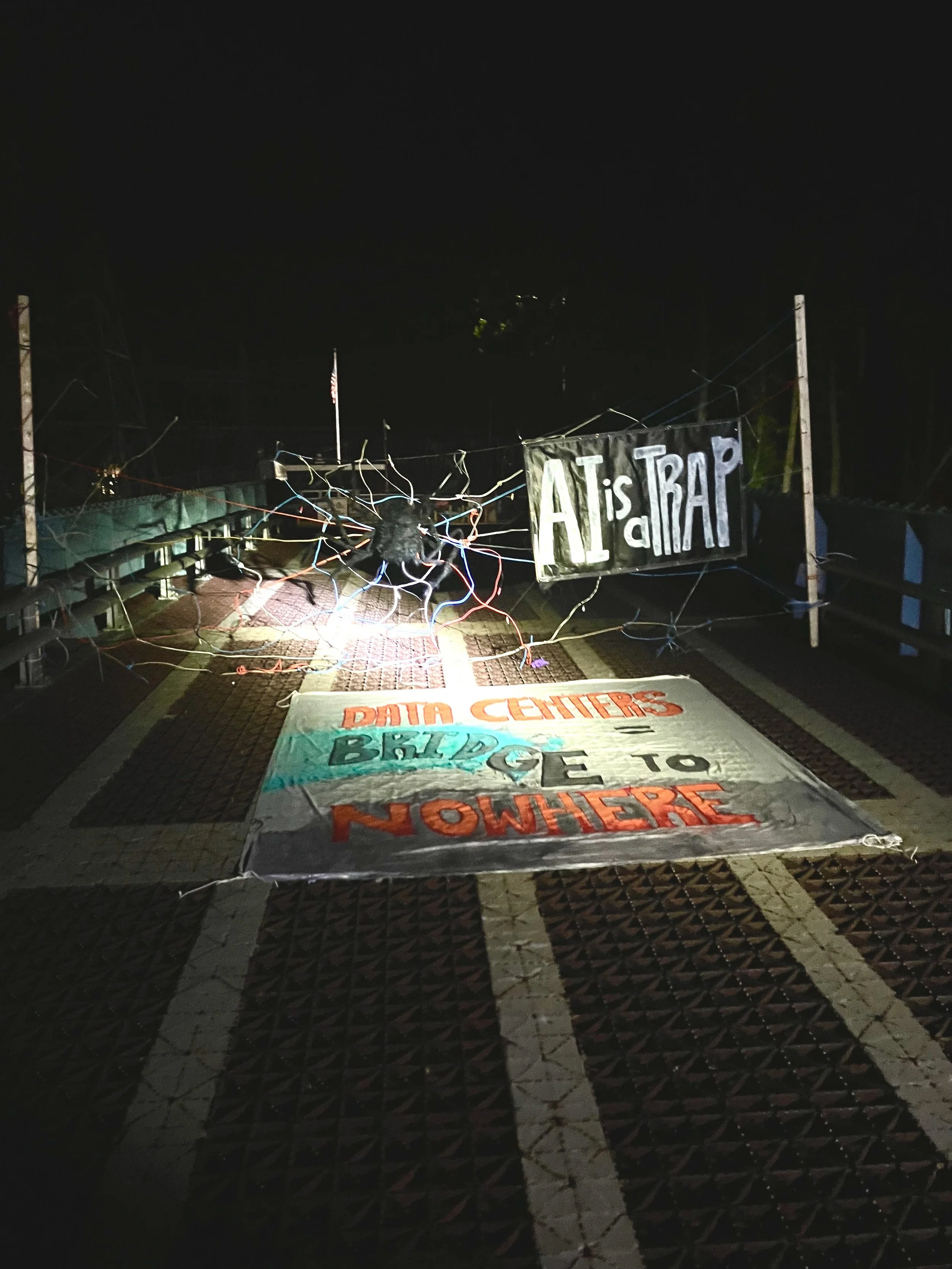
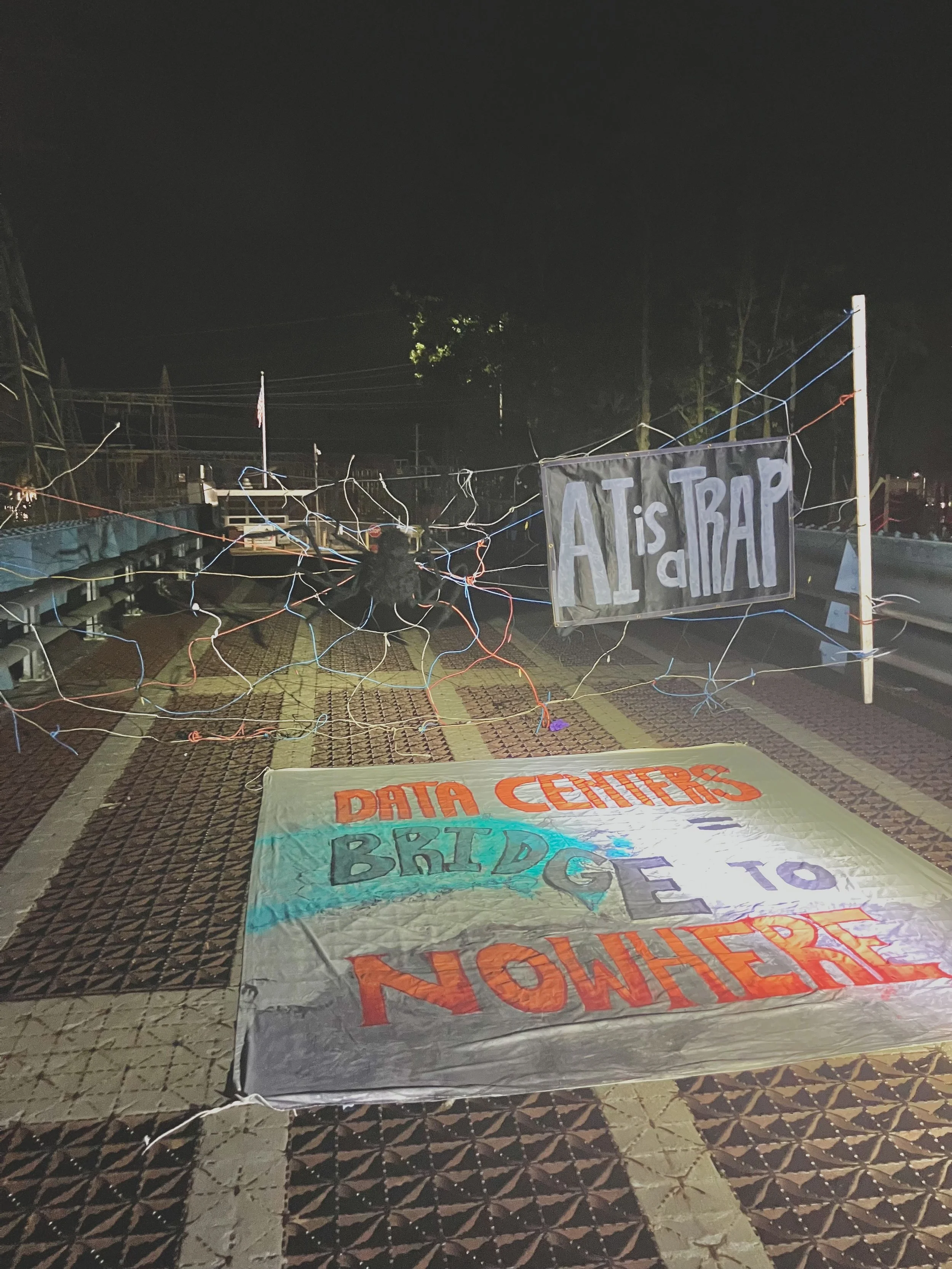
Milford, CT: Activists with the No Coal No Gas campaign blocked the entrance to Devon Station to raise the alarm that nine Connecticut power plants are pending takeover by AI-focused companies which are building hyperscale data centers across the country.
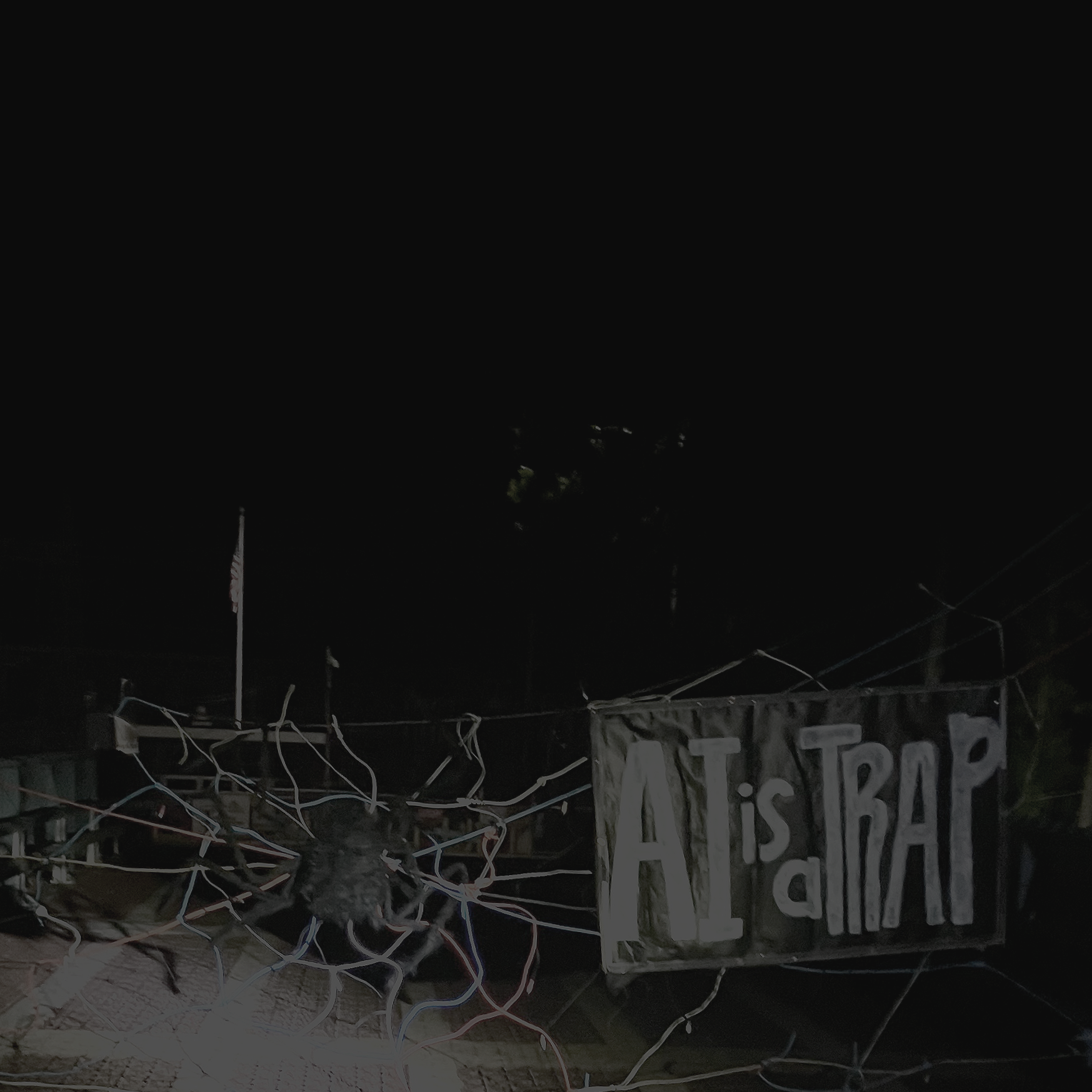
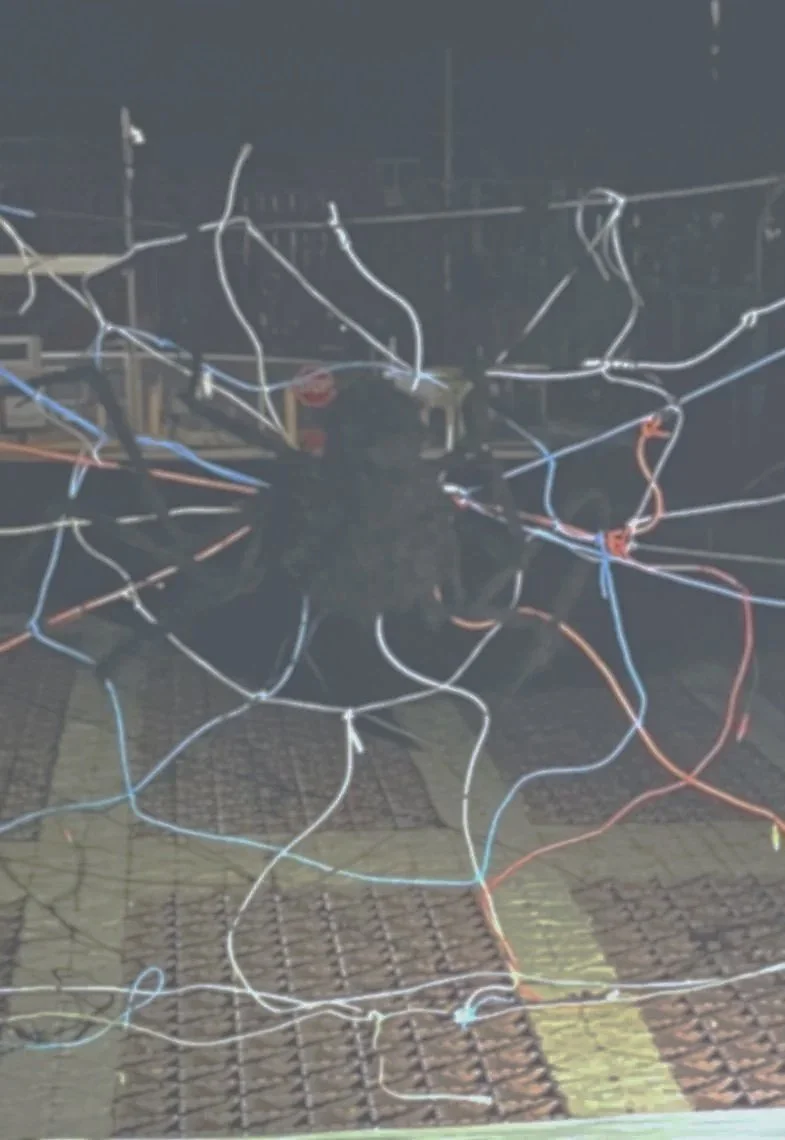
The activists installed a spiderweb woven of old electrical cables across the bridge at the oil-burning plant’s entrance, decked with banners reading "AI is a trap" and "data centers = bridge to nowhere." Multiple vehicles entering the plant were safely halted by the web.
AI-focused corporations Digital Bridge and Soft Bank are seeking to acquire the power plant's owner ArcLight, a private equity firm that is one of the largest owners of power plants in the United States. ArcLight owns 9 power plants in Connecticut, as well as plants in 14 other US states and Canada provinces.
| County | Plant Name | Fuel Type | Town |
|---|---|---|---|
| New Haven | Branford | Oil | Branford |
| New Haven | New Haven Harbor | Oil | New Haven |
| New Haven | Devon | Oil | Milford |
| New London | Montville | Primary oil, secondary gas | Montville |
| Fairfield | Cos Cob | Oil | Greenwich |
| Fairfield | Bridgeport Harbor | Gas | Bridgeport |
| Litchfield | Torrington Terminal | Oil | Torrington |
| Litchfield | Franklin Drive | Oil | Torrington |
| Middlesex | Middletown | Primary gas, secondary oil | Middletown |
DigitalBridge and SoftBank have an explicit intention to expand and focus on their AI capacity, and ArcLight's electrical generation assets will allow them to power data centers in Connecticut and nearby states. "DigitalBridge, SoftBank, and ArcLight are making this move as data centers wreak havoc around the world, making themselves unpopular across the political spectrum," said Isaac Petersen, an organizer with the No Coal No Gas campaign. "Many data center projects receive heavy subsidies from taxes and utility bill fees, then repay local communities by driving up electricity costs, draining the water table, causing rolling blackouts, and polluting the air, water, and soil. The impacts are widespread."
Further complicating matters, eight of ArcLight's power plants in Connecticut are peaker plants, which run only occasionally when energy demands required it. All eight of these peakers deliver less than 2% of their capacity to the regional electrical grid each year, according to data from the United States Energy Information Administration. For the 12 month period from May 2027-May 2028, the regional grid operator has committed $5,696,667.84 in forward capacity payments to ArcLight Devon in exchange for it being available to deliver electritiy to the grid. The sum of subsidizing payments for the same months across all nine ArcLight-owned power plants slated for sale to Digital Bridge and Soft Bank is a stunning $164,849,806.56.
Forward capacity payments are ratepayer-funded subsidies that incentivize power generators to be ready to deliver electricity to the grid at times of peak demand. Without changes in regulation and/or policy, this arrangement could allow the new owners of these power plants to continue to receive the subsidy, while increasing sales of electricity to the grid by as much as 49 times in order to provide power for off-site data centers. If data centers are built on-site, these facilities could retain the subsidies and devote, on average, as much as 98% of their generating capacity to power those facilities.
Either scenario would mean burning oil around the clock at full throttle and a massive increases toxic air emissions, including sulfur and nitrogen gases, as well as fine particulate matter. These pollutants are known to cause respiratory and cardiovascular damage. Burning oil and gas at such increased rates would also drive climate change effects like dangerous heat waves.
In Milford, ArcLight Devon sits on the Housatonic River, directly adjacent to a public boat launch. It is less than a mile upriver from a protected saltmarsh and Audubon Center on the coast of the Atlantic Ocean. Oil-fired power plants require on-site fuel storage, and ramping up generation at this power plant would require more fuel and more frequent deliveries. In a time when this dirty, expensive, and outdated power plant should be retired, its continued use would pose a genuine threat to the health of these coastal ecosystems and to water recreation for local residents.
“Fortunately, this merger is not finalized, and we have opportunities to interfere before any data centers sites get officially proposed,” said Kendra Ford, organizer with the campaign and member of the Consumer Liaison Group Coordinating Committee with the regional electrical grid operator, the ISO-NE. “No Coal No Gas is pursuing regulatory intervention with bodies like the Federal Energy Regulatory Commission and Connecticut Public Utilities Regulatory Authority. These regulators do the right thing far too rarely, but forcing the corporations involved to complete the proper process of public engagement gives us time to spread the word and get organized.”